
Article :- Kartik Rai
Introduction
Dear farmer brothers and sisters, we know that you work day and night for your crop. But along with hard work, if the market trends are also understood, the fruit of hard work can be even sweeter. It often happens that after the crop is ready, the market prices are very low, and when we don't have onions, the prices skyrocket. In this article, we will understand this market puzzle so that you can choose the right time for sowing and earn more profit. This is not just information, but a practical strategy for you.
Three Onion Crops
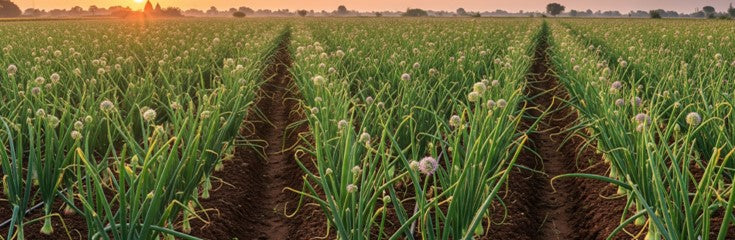
In India, onions are mainly grown in three seasons, and each season has its own importance. It is important to understand them, because market prices depend on these three crops. The biggest crop is Rabi (Rabi). Its sowing takes place in October-November and harvesting in April-May. It accounts for approximately 70% of India's total onion production and can be stored for a long time.
The second crop is Kharif (Kharif), which is grown during the monsoon season. Its sowing takes place in May-June and harvesting in October-November. This crop depends on monsoon rains and is more susceptible to damage due to waterlogging and excessive moisture. Therefore, its yield is often low. The third crop is Late Kharif (Late Kharif), whose sowing takes place in August-September and harvesting in January-February. This crop comes to the market in those months when supply is low between the two major crops.
In India, the sowing and harvesting times are slightly different in each state. You can see the timings for major states in the table below.
Table: Onion Crop and its Timings in India
|
Crop |
Sowing (Seed Sowing) |
Transplanting (Transplanting) |
Harvesting (Harvesting) |
|
Rabi (Rabi) |
October-November |
December-January |
March-May |
|
Kharif (Kharif) |
May-June |
July-August |
October-November |
|
Late Kharif (Late Kharif) |
August-September |
October-November |
January-February |
Understanding Market Prices and the 'Lean Period'
To understand onion prices, it is most important to understand the time when onions arrive in the market. When the Rabi crop comes to the market between April and May, the supply increases all around, which leads to lower prices. Farmers often store their crop and sell it gradually, but this stock starts to run out by August-September.
This is where the most important time of the market begins, which is called the 'lean period'. This period comes between October and December. During this time, the supply of onions in the market becomes very low, because the old stock has run out and the new Kharif crop has not yet fully arrived in the market. This is the time when onion prices rise the most. Therefore, farmers who can bring their crop to the market during this period earn the most profit.
It has also been observed that the price does not always have a direct correlation with the amount of crop coming into the market. This means that prices do not fall just because of a larger crop, but there are other reasons as well. For example, hoarding by merchant groups, which creates an artificial shortage in the market. In addition, prices may vary in each state. For example, the price of onion in Maharashtra can be ₹1321 per quintal, while in Kerala it can reach ₹3267 per quintal.

Apart from weather, reasons that shake the market
Onion market prices do not depend only on the weather, but there are some other factors that make it unstable. The biggest reason is sudden weather changes. Crops are damaged by untimely rains, droughts or floods. This causes a sudden decrease in market supply and prices rise sharply.
The second major reason is government policies. When prices rise too high, the government immediately takes steps to provide relief to urban consumers. For example, banning onion exports or increasing export duties. Additionally, the government releases onions from its buffer stock through organizations like NAFED to increase supply and bring down prices. These steps are good for consumers, but they harm farmers who are hoping to get a good price for their crop. Furthermore, the problem of long-term onion storage and a poor supply chain also destabilize prices. High humidity makes it difficult to store Kharif crops, which increases post-harvest losses. All these factors together create uncertainty in the market, making it even more difficult to understand the market.
How Parth AI can help you make the right decision
Tracking so many market factors alone is not easy for any farmer. To simplify this challenge, Parth Ai by Krishiverse is a great solution. It is a digital companion that provides you with the right information at the right time, so that you can get the full benefit of your hard work. It is not just a simple app, but a part of modern agricultural technology that can change your farming methods.
Parth Ai provides you with live prices from different mandis in India directly on your mobile. This allows you to decide when and in which mandi to sell your crop to get the best price. Along with this, it gives you very accurate weather forecasts. You can know before sowing whether it will rain in the coming days or not, so that you can protect your crop from unseasonal rain. Krishiverse's "Neer" products allow you to control your water motor from your mobile, which also reduces water wastage. It is a friend who gives you complete information about both the market and the weather, so that you can make every decision carefully.
Conclusion: Your strategy for sowing time
Now that you understand the onion market and weather, you can make a correct strategy for your farming.
- Rabi Strategy (low risk, low price):If you want stable and low-risk farming, then grow Rabi crops. This will give you a certain income even at low prices and can also be stored.
- Kharif Strategy (high risk, high price):If you want to earn more profit and can take market risk, then grow Kharif crops. This will give you a chance to enter the market during "off-season" when prices are highest. But for this, you will have to pay close attention to the weather.
- Balanced Approach :The best approach is to divide your land into two parts. Grow Rabi crops in one part to ensure a stable income, and Kharif or late Kharif crops in the other part to take advantage of good market prices. Whichever path you choose, always remember one thing: information is your greatest strength.